StarkWare CEO suggests 4% annual Bitcoin inflation to replace 21M cap

StarkWare CEO Eli Ben-Sasson argued that Bitcoin private keys get lost over time, meaning the amount of usable Bitcoin will diminish. Many disagree.
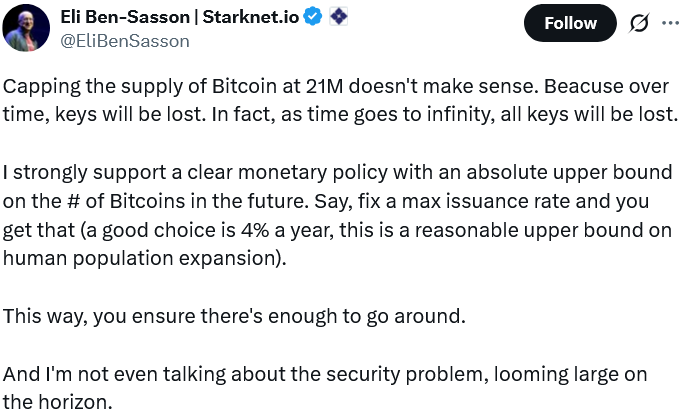
The debate over whether Bitcoin’s fixed supply cap should be lifted has resurfaced after StarkWare CEO Eli Ben-Sasson suggested Tuesday that it should replaced with a 4% annual issuance rate.
In a post to X on Tuesday, Ben-Sasson said the current 21 million cap “doesn’t make sense” because private keys are lost over time and “as time goes to infinity, all keys will be lost.”
Crypto wallet hardware provider Ledger estimated in November that up to 4 million Bitcoin had been burned or permanently lost. Ben-Sasson said he still supports a hard upper bound on Bitcoin’s supply, and that a 4% annual inflation rate roughly tracks the growth of the human population.
Bitcoin’s fixed cap has long been one of its core selling points, underpinning the “digital gold” narrative and drawing on Austrian economics, where a fixed money supply protects against monetary debasement and, in theory, preserves purchasing power over time. Many Bitcoiners have argued that changing the cap would undo the very thing that makes Bitcoin unique.
Source: Eli Ben-Sasson
Bitcoiners have also said the loss of private keys improves Bitcoin’s supply-demand dynamics because one can’t sell what one doesn’t have access to. One of the biggest advocates of this feature is Strategy executive chairman Michael Saylor, who plans to burn his Bitcoin private keys upon his death as a “pro-rata contribution” to other Bitcoin holders, making their coins scarcer in the process.
Get to know Godleak
Godleak crypto signal is a service which provide profitable crypto and forex signals. Godleak tried to provide you signals of best crypto channels in the world.
It means that you don’t need to buy individual crypto signal vip channels that have expensive prices. We bought all for you and provide you the signals with bot on telegram without even a second of delay.
Godleak crypto leak service have multiple advantages in comparision with other services:
- Providing signal of +160 best crypto vip channels in the world
- Using high tech bot to forward signals
- Without even a second of delay
- Joining in +160 separated channels on telegram
- 1 month, 3 months , 6 months and yearly plans
- Also we have trial to test our services before you pay for anything
For joining Godleak and get more information about us only need to follow godleak bot on telegram and can have access to our free vip channels. click on link bellow and press start button to see all features
Join for Free
☟☟☟☟☟
https://t.me/Godleakbot
Also you can check the list of available vip signal channels in the bot. by pressing Channels button.
Bitcoiners bark at 4% Bitcoin inflation proposal
Ben-Sasson’s post was met with heavy criticism.
One X user argued that Bitcoin is divisible into 2.1 quadrillion base units, called satoshis, in an effort to counter Ben-Sasson’s claim that there won’t be enough Bitcoin “to go around.”
However, Ben-Sasson argued that those 2.1 quadrillion units would also trend toward zero over time because of lost keys.
Other opponents argued that lifting Bitcoin’s fixed cap would make it like other cryptocurrencies. However, Ben-Sasson said Bitcoin would retain its scarcity, provided that the inflation rate remained fixed.
The answer could be in Zcash’s proposed fix
The founder of Zcash, Bryce “Zooko” Wilcox, recommended that Bitcoin developers follow a proposal currently being considered in the Zcash ecosystem, since the privacy-focused network also relies on miners to secure the network and has a fixed supply cap of 21 million Zcash (ZEC).
The “Network Sustainability Mechanism” proposal seeks to keep ZEC’s fixed cap intact but lets users burn the token, which is gradually reissued as block rewards over a four-year period to ease pressure on miner incentives without lifting the hard limit.
However, Bitcoin developers, miners and node operators would need to reach consensus for such a change to occur, given the network’s decentralized governance model, which makes it challenging to implement protocol-level changes.